
Published · Last updated
Wine Room Cooling Units: How to Choose and Size One
A wine room and a wine cellar need the same thing from a cooling unit. How to size one from the room as built, and what the room must have first.
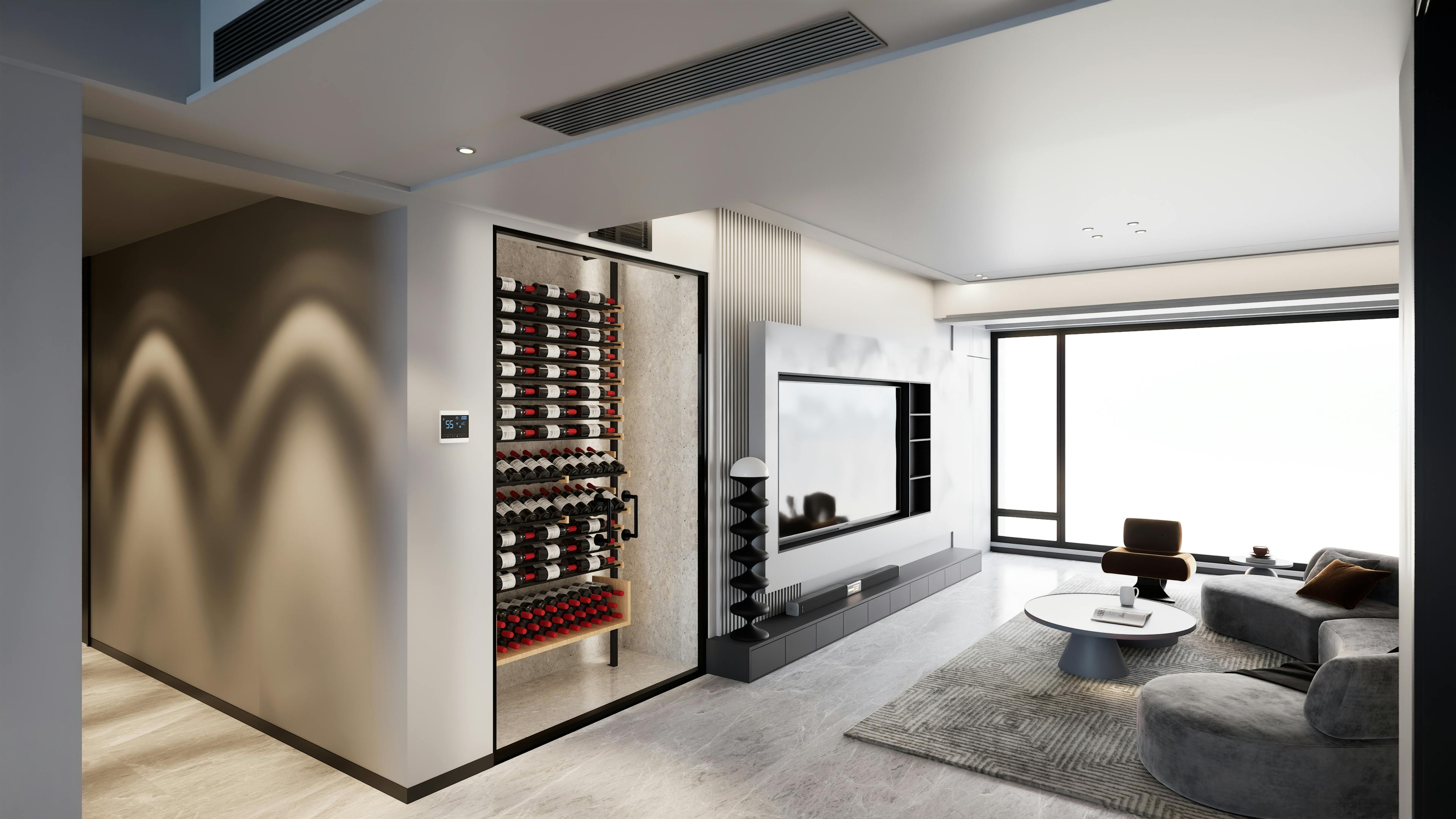
A wine room cooling unit is a self-contained or split system that holds a closed, insulated room at a steady cellar temperature, and the right one is chosen from the room as it is built, not from a name or a square-foot rule. "Wine room" and "wine cellar" describe the same job. A room above ground, a well-insulated converted small room (see the guide on how to insulate a wine cellar), a basement corner and a glass-walled showpiece all ask the same thing of the cooling system: remove the heat that gets in, and do it steadily.
What a wine room needs before any unit
A cooling unit can only remove the heat the room lets in. Three things in the room decide how hard it works.
- Insulation. R-20 or better in the walls, ceiling and floor.
- A continuous, sealed vapor barrier on the warm side of the insulation.
- An airtight door and sealed penetrations. Light boxes, outlets and gaps under the door bring in warm, humid air all day.
Older homes were rarely built with a cellar in mind, so most rooms start without these. That is common, and it is straightforward to fix during the build. See the guide on how to build a wine cellar.
The main types of wine room cooling
A through-the-wall unit suits a room that shares an interior wall with a living space. It needs no ductwork and no outdoor condenser. For the full comparison, see the guide on through-the-wall vs ducted and split systems.
How to size one
Size from the heat load of the room as built. The load depends on:
- Wall, ceiling and floor area, and their insulation.
- Glass area, and whether it is sealed double-pane.
- What sits on the other side of each wall: a conditioned room, an unconditioned space or an exterior wall.
- Lighting and how often the door opens.
Volume alone is a weak guide. A well-built room asks little of a unit, and a leaky one of the same size can ask as much as a much larger room. The BTU calculator takes the dimensions, insulation and glass area and returns a starting figure in about a minute.
Where the WR2500 fits
The Wine-R WR2500 is a self-contained through-the-wall unit. It sits in one opening in an interior wall: the cold side faces the room, the warm side faces a conditioned space. These are the figures that decide whether a room is a fit. A room beyond these limits, or one that is mostly glass, gets a heat-load review of the project details before purchase, with a recommendation within one business day, and the unit does not suit an exterior wall or a sealed cavity.
What to check before you buy
Five questions about the room settle most of it. Each one maps to something the unit relies on. If one of these is open, the BTU calculator and the compatibility check show where the room stands.
FAQ
It depends on the room's heat load: insulation, glass, what sits behind each wall, and how tight the door and penetrations are. The BTU calculator gives a starting figure from those inputs.
Yes. The terms describe the same equipment. The room around the unit decides what it needs to do. If you are weighing a household air conditioner, see the wine cellar air conditioner guide.
Yes, within limits. The WR2500 covers up to 700 cubic feet with glass walls, and the glass must be sealed double-pane.
The WR2500 does not add or control humidity. Steady humidity comes from the room's construction. See the guide on wine cellar humidity control.
Yes. The WR2500 produces condensate during normal cooling cycles and needs a continuous downward drain line.
Liability and warranty considerations
The WR2500 is sold under Wine-R’s Terms of Sale and Limited Warranty. Wine-R’s warranty covers unit parts for two years from the original purchase date.
Warranty coverage is voided by, among other conditions:
- Damage from improper installation, poor insulation, or oversized or unsealed rooms
- Use of extension cords, switch-controlled outlets, or non-dedicated circuits
- Use of single-pane or non-insulated glass in the cellar envelope
- Installation through an exterior wall, into a sealed cavity, or into an unventilated cabinet
- Service performed by anyone other than Wine-R or a Wine-R authorized technician
- Condensate drain not installed to the published requirements (3/8 in ID, continuous downward slope, pump where required)
Pre-validation by Wine-R confirms unit fitment against declared measurements only. The owner or installer is responsible for envelope construction, wall structural assessment, electrical compliance, drainage routing, and ongoing operating conditions. Wine-R is not liable for incidental, consequential, special, or indirect damages, including damage to property or to the contents of the wine cellar, arising from installation, site conditions, or operating environment. See the Terms of Sale.
About this information
This content is general information for owners evaluating wine cellar cooling options. It is not a diagnosis of any specific unit and not a recommendation to repair or replace any product. Wine-R is not affiliated with, sponsored by, or endorsed by any other manufacturer referenced on this page. All third-party product names and trademarks are the property of their respective owners and are used for identification and compatibility reference only. Third-party specifications come from publicly available manufacturer information and may change without notice. Compatibility with an existing opening does not by itself confirm suitability: cooling capacity must be validated against the cellar's size and construction, and the WR2500 requires a condensate drain line and a dedicated 115V/60Hz/15A circuit. Fit and sizing are confirmed through Wine-R's pre-validation process before any unit ships.
About this guide
This guide is built and reviewed by the Wine-R engineering team. Wine-R specializes in through-the-wall wine cellar cooling. Recommendations follow the WR2500 manufacturer specifications and standard residential building-science references.
See if it fits your cellar
A wine room makes a good fit for a through-the-wall unit when it is insulated, sealed and backs onto a conditioned room. If you have your dimensions and know how the walls and floor are built, the BTU calculator gives you a sizing starting point. To see the through-the-wall unit, see the WR2500.