
Published · Last updated
Through-the-wall vs ducted split: how to choose your wine cellar cooling architecture
Two architectures cover wine cellar cooling: through-the-wall self-contained units and ducted split systems. The choice comes down to cellar size, glass exposure, and where heat can be exhausted. This guide walks through how each architecture works, the realistic capacity range of each, and the four questions that drive the choice.
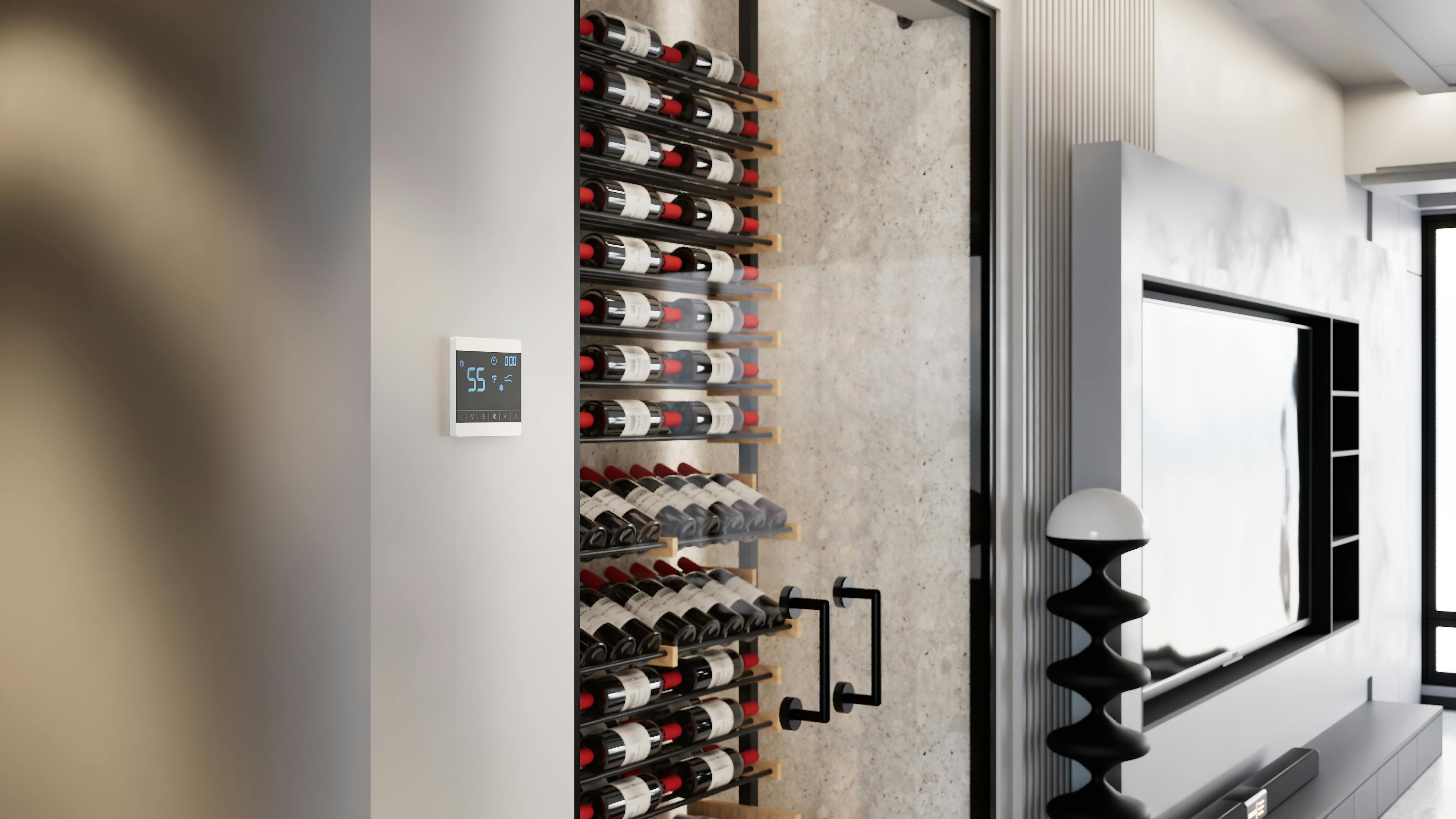
The short answer
A through-the-wall self-contained unit is the right architecture for most wine cellars between 50 and 1,500 cubic feet, when the cellar has R-20 minimum insulation and shares a wall with a non-conditioned space for warm-side venting.
A ducted split system is the right architecture for cellars above 1,500 cubic feet, for cellars with extensive glass walls, for builds where no adjacent non-conditioned space is available for venting, or for installations with commercial duty-cycle requirements.
The decision is rarely about features. It comes down to whether the heat load fits the unit capacity and whether the install constraints allow self-contained venting. Get those two right and the rest follows.
Homeowners, builders, restaurants, and commercial buyers
Anyone evaluating cooling architecture for a wine cellar between 50 and 5,000 cubic feet. Covers the through-the-wall versus ducted split decision and where each architecture is the right call. Ductless mini-splits are not part of this conversation — they are room-conditioning systems, not wine cellar systems.
How through-the-wall cooling works
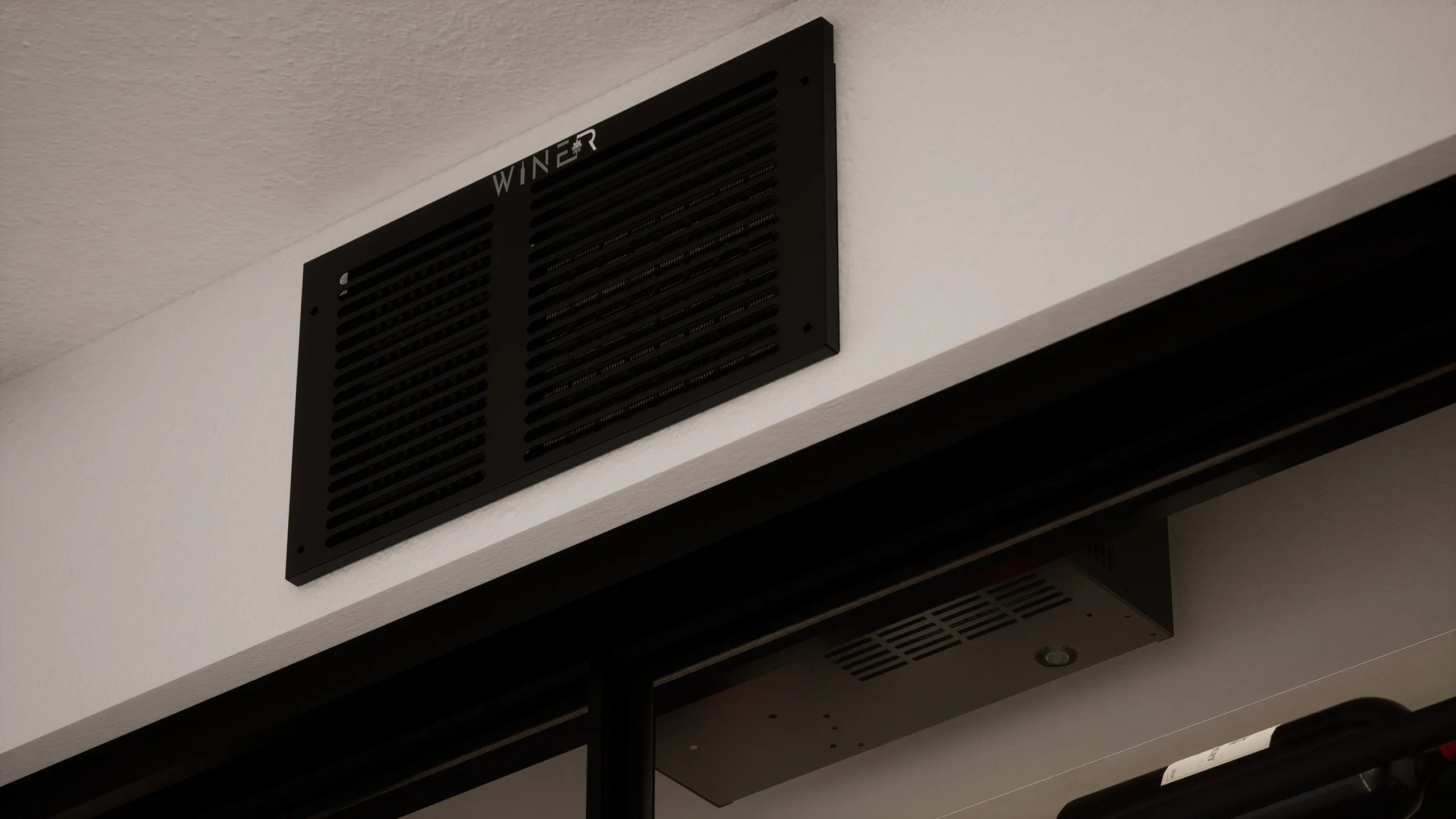
A through-the-wall unit is a single self-contained appliance. The condenser, evaporator, fan, and compressor live inside one housing. The unit mounts in a wall opening between the cellar (cold side) and an adjacent non-conditioned space (warm side, where heat exhausts).
The cellar side has the cold-air intake and discharge. The warm side has the heat exhaust and the compressor housing. No refrigerant lines run outside the appliance. No ductwork is required. Power is usually a standard 120V/15A outlet, though larger units can require 120V/20A.
The architecture works because heat removed from the cellar exits directly into a non-conditioned space (utility room, garage, mechanical closet). That space needs to remain cool enough to absorb the exhaust, which is why warm-side venting requirements matter.
How ducted split cooling works
A ducted split system separates the condenser and evaporator into two units connected by refrigerant lines. The condenser sits outside the conditioned space (outdoors, garage, or remote utility room). The evaporator coil sits inside the cellar, often above the ceiling or in a closet adjacent to the cellar. Ducts distribute cold air through the cellar.
Refrigerant lines (copper, insulated, brazed on-site) connect the two units. The condenser exhausts heat far from the cellar, which is what lets the architecture scale to large cellars and handle glass exposure. Power can be 120V or 240V depending on capacity.
The architecture is more flexible than through-the-wall and more complex. Installation requires professional refrigerant work. The condenser location matters for noise, maintenance access, and ambient temperature performance.
Through-the-wall capacity across the market
Residential through-the-wall self-contained units span a wider range than buyers often realize. The category breaks into three rough tiers.
Compact tier (50 to 300 cubic feet)
Cabinet-style and slimline through-the-wall units designed for wine walls, display cellars, and small closet conversions. Best for spaces where wall opening size is constrained.
Mid-range tier (50 to 900 cubic feet)
Standard residential through-the-wall units. The Wine-R WR2500 sits in this tier. The unit covers cellars up to 700 cubic feet with glass walls and up to 900 cubic feet in fully enclosed installations. Most American residential wine cellars fall into this class. The mid-range tier offers the best combination of install simplicity, DIY-feasibility, and standard outlet power.
Large tier (900 to 1,500 cubic feet)
Extended-capacity through-the-wall units exist for cellars in this range. For Wine-R projects in this range, submit your project details and we will come back with a recommendation within one business day. The required compressor size, electrical breakdown, and warm-side venting volume push the build toward ducted split as the more efficient build.
Above 1,500 cubic feet of cellar volume, through-the-wall architecture starts to lose its practical advantages. The required compressor size, electrical breakdown, and warm-side venting volume push the build past what a ducted split system handles more efficiently.
Ducted split capacity across the market
Ducted split systems start where larger through-the-wall ends and scale much further.
Compact split (300 to 1,500 cubic feet)
Small split systems with compact condensers, often used in builds where through-the-wall would work but the install constraints rule it out (no warm-side venting, exterior wall installations, casual routing needs).
Standard split (1,500 to 4,000 cubic feet)
The workhorse class. Covers most large residential cellars and small commercial spaces.
Large split (4,000 to 10,000+ cubic feet)
Commercial-grade systems for large wine rooms, retail wine displays, and small wineries.
Side by side: the architectures compared
Glass exposure shifts the architecture decision
Standard insulated glass has an R-value of 3 to 4. An insulated wall is R-15 to R-25. Per square foot of exposure, a glass wall lets through roughly 4 to 6 times more heat than an insulated wall. A cellar with a glass façade can need 40 to 60 percent more cooling capacity than the same cellar with insulated walls. Through-the-wall units in the compact and mid-range tiers handle some glass exposure (the Wine-R WR2500 covers cellars up to 700 cubic feet with glass walls), but ducted splits handle large glass exposure best. If your cellar has substantial glass coverage, the safer architecture is a ducted split sized with glass exposure factored in, or a multi-unit configuration reviewed case by case.
How to decide: four practical questions
- How many cubic feet is the cellar? Under 900 cubic feet in fully enclosed installations (or up to 700 cubic feet with glass walls): the Wine-R WR2500 and most mid-range through-the-wall units are in play. Between 900 and 1,500 cubic feet: larger through-the-wall units or a compact ducted split, reviewed case by case. Above 1,500 cubic feet: a ducted split is typically the only practical answer.
- Does the cellar have glass walls or a large glass door? Yes (substantial glass coverage): bias toward ducted split or a multi-unit configuration reviewed case by case. Through-the-wall units handle uniform heat loads better than the elevated and uneven loads that glass creates. Limited or no glass: through-the-wall stays in play for cellars under 1,500 cubic feet.
- Where can heat exhaust? Through-the-wall requires a non-conditioned space (garage, utility room, mechanical closet) on the warm side of the wall. If the cellar shares walls only with conditioned rooms, or with the outdoors, a ducted split is the workable architecture instead.
- What is the installation tolerance? Through-the-wall installs are DIY-feasible for most American homes with basic carpentry tools, especially when replacing an existing unit. Ducted split installs require professional refrigerant work and often a licensed HVAC contractor. The cost difference between the two architectures shows up most in install labor.
What happens when the architecture is wrong
Undersized through-the-wall in a too-large cellar. The compressor runs almost continuously, ambient temperatures in the cellar drift up during hot weather, and the unit wears out faster than its expected service life. The fix is replacing the unit with a correctly sized one, often after only a few years.
Through-the-wall in a glass-walled cellar without capacity headroom. The unit cycles aggressively trying to handle uneven heat load near the glass. Temperature stability suffers, the compressor sees more on-off events than it was designed for, and the wine experiences temperature swings that affect long-term storage.
Through-the-wall venting into a conditioned room. The exhaust heat raises the temperature of the adjacent room, the unit reads a hotter warm-side temperature, and efficiency drops. In some cases the unit cannot keep up. The fix is rerouting the exhaust, which often means a different unit or a different architecture.
Oversized cooling, any architecture. A unit that is too large cycles on and off frequently, never reaching steady state. Compressor wear accelerates, the cellar temperature swings more than the wine should see, and the install costs more than it needed to.
Getting the architecture right at the start is the cheapest move in a cellar build. The numbers fall out of an honest BTU calculation and an honest assessment of where heat can exhaust.
Common architecture questions
Yes. Through-the-wall units can handle cellars up to roughly 1,500 cubic feet of effective volume. The Wine-R WR2500 specifically covers up to 700 cubic feet with glass walls and up to 900 cubic feet in fully enclosed installations. For cellars beyond this range, submit your project details and our technical team will come back with a recommendation within one business day.
Roughly 1,500 cubic feet of effective volume is the practical upper limit for residential through-the-wall units. Above that, the compressor size, electrical load, and warm-side venting space push the build toward a ducted split.
Practical ducted split installs typically start around 300 cubic feet. Below that, the install complexity and cost are difficult to justify versus a through-the-wall unit. A ducted split makes sense when capacity, glass, or venting constraints rule out through-the-wall.
Not necessarily. The condenser can sit outdoors, in a garage, or in a remote utility space. What matters is ambient temperature where the condenser runs (cooler is better for efficiency) and noise isolation from living spaces. Many residential ducted splits use indoor-located condensers in garages or mechanical rooms.
For most American homes, yes. The install is DIY-feasible with basic carpentry tools, follows the manual step by step, and connects to a standard 120V outlet. Larger through-the-wall units require slightly more involved electrical work. Ducted split installs typically require a licensed HVAC contractor for the refrigerant work.
Different architecture. A mini-split is a heat pump designed for room conditioning, not wine cellars. It cannot maintain the cellar temperature stability that wine storage needs over years. Wine-specific ducted split systems are engineered for narrow temperature ranges and humidity control. A mini-split is the wrong tool for this job.
Through-the-wall units exhaust noise to the warm side of the wall (typically a non-conditioned space) so most of the operating sound stays out of the cellar. Ducted splits can be quieter in the cellar (only the evaporator coil runs there) but the condenser noise has to be located somewhere. Both architectures can be quiet enough for residential use when installed correctly.
Reliability depends more on correct sizing and installation than on architecture. A correctly sized through-the-wall unit in a properly insulated cellar can run for 10 to 15 years. A correctly sized ducted split can run for 12 to 18 years. The longer service life of ducted split mostly reflects the lower compressor cycling that larger systems enjoy.
This range requires individual evaluation. The WR2500 covers up to 900 cubic feet in fully enclosed installations, and a multi-unit configuration may be the right answer for the range up to 1,500. Above that, a ducted split is typically the right answer for both residential and commercial installations. Submit your project details and we will come back with a recommendation within one business day.
About this information
This content is general information for owners evaluating wine cellar cooling options. It is not a diagnosis of any specific unit and not a recommendation to repair or replace any product. Wine-R is not affiliated with, sponsored by, or endorsed by any other manufacturer referenced on this page. All third-party product names and trademarks are the property of their respective owners and are used for identification and compatibility reference only. Third-party specifications come from publicly available manufacturer information and may change without notice. Compatibility with an existing opening does not by itself confirm suitability: cooling capacity must be validated against the cellar's size and construction, and the WR2500 requires a condensate drain line and a dedicated 115V/60Hz/15A circuit. Fit and sizing are confirmed through Wine-R's pre-validation process before any unit ships.
Liability and warranty considerations
The WR2500 is sold under Wine-R’s Terms of Sale and Limited Warranty. Wine-R’s warranty covers unit parts for two years from the original purchase date.
Warranty coverage is voided by, among other conditions:
- Damage from improper installation, poor insulation, or oversized or unsealed rooms
- Use of extension cords, switch-controlled outlets, or non-dedicated circuits
- Use of single-pane or non-insulated glass in the cellar envelope
- Installation through an exterior wall, into a sealed cavity, or into an unventilated cabinet
- Service performed by anyone other than Wine-R or a Wine-R authorized technician
- Damage from drainage installation, blockage, overflow, or any drainage failure
Pre-validation by Wine-R confirms unit fitment against declared measurements only. The owner or installer is responsible for envelope construction, wall structural assessment, electrical compliance, drainage routing, and ongoing operating conditions. Wine-R does not warrant against water damage, mold, finish degradation, or property loss caused by installation, drainage configuration, site conditions, or operating environment.
About this guide
This guide is built and reviewed by the Wine-R engineering team. Wine-R specializes in through-the-wall wine cellar cooling and has supported replacements that reuse an existing opening across North America. Recommendations follow the WR2500 manufacturer specifications and standard residential building-science references.
Find the right architecture for your cellar
The BTU calculator factors cubic footage, climate, glass exposure, and insulation, and returns a recommendation for the architecture and unit size that fits the build. If the calculator returns a fit to the Wine-R WR2500 (up to 700 cubic feet with glass walls or up to 900 cubic feet in fully enclosed cellars, R-20 insulation, warm-side venting available), the WR2500 is the simplest answer: $2,450 USD, ships direct to the 48 contiguous US states, and a 2-year parts warranty supported by the Wine-R North American service team. For cellars outside the WR2500 range, the calculator returns guidance on what architecture and capacity class fits the build.