
Published · Last updated
Wine Cellar Air Conditioner vs Cooling Unit: What Is Different
Can a room or window air conditioner cool a wine cellar? What differs from a cellar cooling unit, and when each one makes sense.
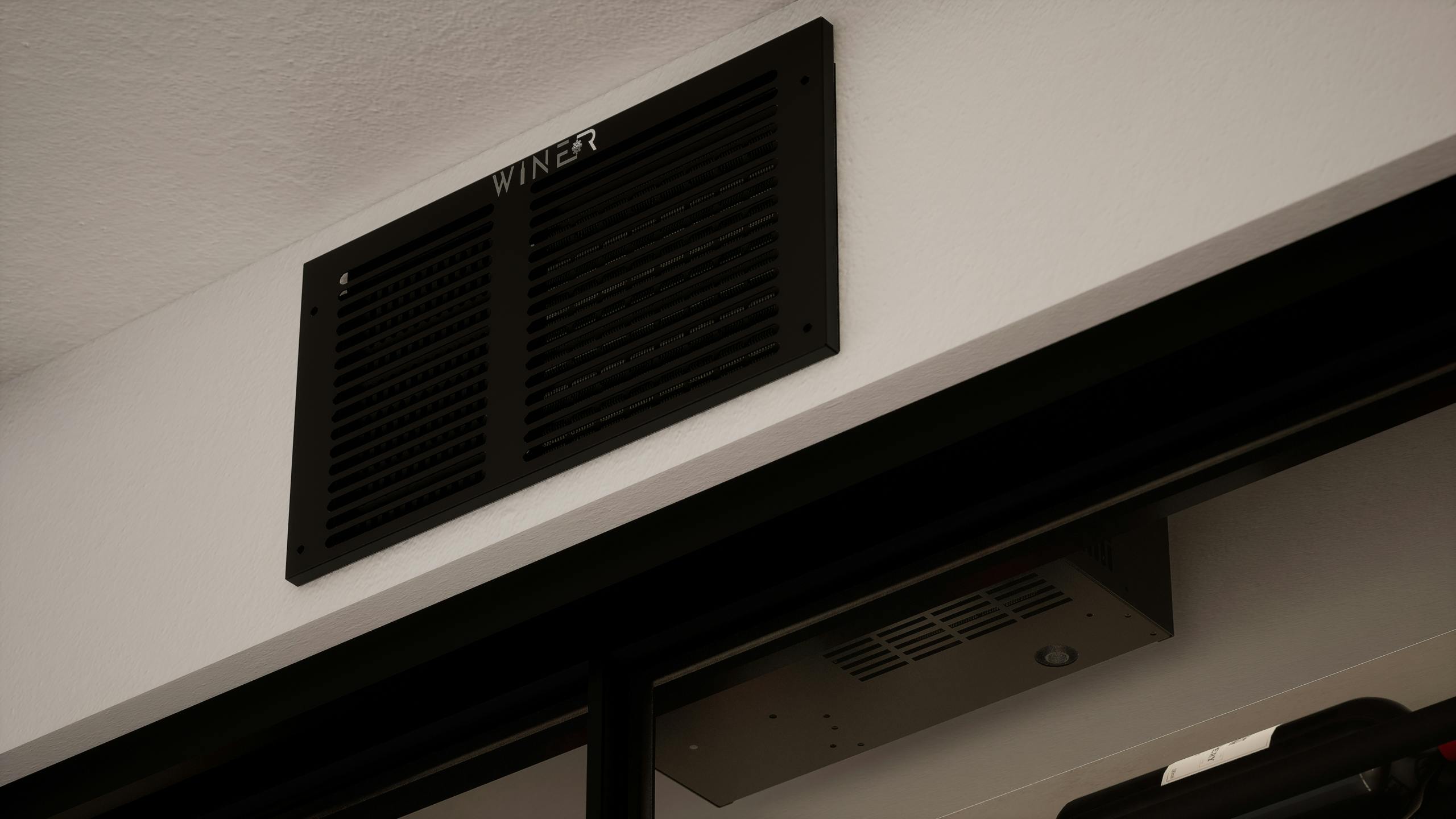
A standard room or window air conditioner is built to keep people comfortable, and a wine cellar cooling unit is built to hold a closed room at a steady, cooler setting around the clock. For a wine cellar, that difference decides which one works.
Why a standard air conditioner struggles in a cellar
Its settings stop where comfort stops. A room air conditioner's thermostat is designed for living spaces. It cannot be set to the lower levels a cellar needs.
It cycles hard. Comfort units are sized to cool a warm room quickly and then switch off. In a small closed cellar that means frequent on-off cycles and wide swings, not a steady condition.
It is not made for continuous cool running. Run at the lowest settings, a comfort unit can form ice on the coil, and then it stops cooling until it thaws.
It is made to be installed in a window or a sleeve. A cellar rarely has either, and cutting an opening in an exterior wall brings in outside heat and moisture.
None of this is a mistake on anyone's part. Air conditioners and cellar cooling units were built for different jobs, and the names overlap in search results.
How a comfort unit behaves in a closed room
A living room has people coming and going, windows, and a thermostat that is happy to be off half the day. A cellar is the opposite: a small sealed volume that should change slowly, day and night.
When a comfort unit is placed in that setting, three things tend to happen:
- The room cools in a burst, the unit shuts off, and the room drifts warmer until it starts again. Over a week that pattern is a long series of small swings.
- Comfort units remove moisture in bursts as they cool a room that was never sealed for it. A cellar cooling unit also produces condensate (it needs a drain line), but it runs steadily in a sealed, vapor-barriered room, and that construction, not the equipment, sets the humidity level.
- At the lowest settings the coil can ice over. The unit keeps running, but the air stops being cooled until the ice thaws.
A cellar cooling unit is built around the opposite pattern: long, steady running, a coil designed for low settings, and a drain line for the condensate it produces.
What a wine cellar cooling unit is designed for
A cellar cooling unit holds a lower, steady setting in a sealed, insulated room, runs for long periods without icing, and handles the condensate it makes with a drain line. A self-contained through-the-wall unit does this from a single opening in an interior wall, with the cold side facing the cellar and the warm side facing a conditioned room.
Side by side
What about portable units and mini-splits?
Portable air conditioners
They share the limits above, and they add one more: a portable unit has to push its heat out of the room through a hose. In a sealed cellar that means a hole in the envelope, which defeats the insulation and the vapor barrier.
Ductless mini-splits
They are efficient comfort equipment and a common choice for living spaces. Most are designed around comfort settings, so check the lowest setting the manufacturer publishes before planning a cellar around one.
Systems made for cellars
The setting range, the drain and the running pattern are part of the design, which removes the guesswork.
When a different system makes sense
Through-the-wall unit
The cellar shares an interior wall with a conditioned room. No ducts and no outdoor condenser.
Ducted or split system
The room is far from a shared wall, or the layout favors duct runs and a remote condenser.
Neither
A cabinet or a freestanding wine fridge holds bottles, not a room.
For a closer comparison of the two cellar-grade options, see the guide to types of wine cellar cooling systems and the guide on through-the-wall vs ducted and split systems.
How the size of the unit gets decided
Sizing a cellar unit is a heat-load calculation, not a guess from square footage. Five things set the load.
- The walls, floor and ceiling, and how well each is insulated.
- Glass, which adds more load than the same area of insulated wall.
- The door and its seal.
- Lighting and any equipment inside the room.
- The conditions on the warm side of the unit.
The Wine-R manual asks for a heat-load calculation before purchase for this reason. The BTU calculator walks through these inputs from your room as built, and it is the quickest way to see where you stand before comparing units.
What a through-the-wall unit needs from the room
If a through-the-wall unit looks like the right fit, confirm these points first. For the WR2500 they come straight from the manual.
- An interior wall, never an exterior wall, a sealed cavity or an unventilated cabinet.
- A wall between 5.5 and 14 inches thick, with a cutout of 15 5/8 by 9 1/4 inches.
- Clear space: 12 inches in front of the cold-side grille and 18 inches in front of the warm-side exhaust.
- A drain line, 3/8 inch inside diameter with a continuous downward slope, or a condensate pump.
- A dedicated 115V, 60Hz, 15A circuit, with no extension cords or shared loads.
- R-20 insulation on the walls, ceiling and floor, a continuous sealed vapor barrier and double-pane sealed glass only.
The room still matters
Any cooling system works only as well as the room it serves. R-20 or better insulation on the walls, ceiling and floor, a continuous sealed vapor barrier and an airtight door set how hard the unit works. The BTU calculator shows where a room stands. For a full build, see the guide on how to build a wine cellar, and for glass-walled or converted rooms, the wine room cooling unit guide.
FAQ
It is not a good fit. A comfort unit cannot reach cellar settings, cycles frequently, and can ice up at low settings.
The same limits apply, and a portable unit also needs a way to vent its heat out of the room.
"Air conditioner" is the common search term. The equipment made for cellars is a wine cellar cooling unit.
Check the lowest setting the manufacturer publishes. Most mini-splits are designed for comfort settings, and a system built for cellars avoids the question.
Comfort units remove moisture in bursts as they cool a room that was not sealed for it. A cellar cooling unit also produces condensate, but in a sealed, vapor-barriered room the construction sets the humidity level. See the humidity guide.
An interior wall, a drain line and a dedicated circuit. For the Wine-R WR2500 that is a 115V, 60Hz, 15A dedicated circuit. The compatibility check shows whether an existing opening fits.
Use the BTU calculator, which sizes from the room as built.
Liability and warranty considerations
The WR2500 is sold under Wine-R’s Terms of Sale and Limited Warranty. Wine-R’s warranty covers unit parts for two years from the original purchase date.
Warranty coverage is voided by, among other conditions:
- Damage from improper installation, poor insulation, or oversized or unsealed rooms
- Use of extension cords, switch-controlled outlets, or non-dedicated circuits
- Use of single-pane or non-insulated glass in the cellar envelope
- Installation through an exterior wall, into a sealed cavity, or into an unventilated cabinet
- Service performed by anyone other than Wine-R or a Wine-R authorized technician
- Condensate drain not installed to the published requirements (3/8 in ID, continuous downward slope, pump where required)
Pre-validation by Wine-R confirms unit fitment against declared measurements only. The owner or installer is responsible for envelope construction, wall structural assessment, electrical compliance, drainage routing, and ongoing operating conditions. Wine-R is not liable for incidental, consequential, special, or indirect damages, including damage to property or to the contents of the wine cellar, arising from installation, site conditions, or operating environment. See the Terms of Sale.
About this information
This content is general information for owners evaluating wine cellar cooling options. It is not a diagnosis of any specific unit and not a recommendation to repair or replace any product. Wine-R is not affiliated with, sponsored by, or endorsed by any other manufacturer referenced on this page. All third-party product names and trademarks are the property of their respective owners and are used for identification and compatibility reference only. Third-party specifications come from publicly available manufacturer information and may change without notice. Compatibility with an existing opening does not by itself confirm suitability: cooling capacity must be validated against the cellar's size and construction, and the WR2500 requires a condensate drain line and a dedicated 115V/60Hz/15A circuit. Fit and sizing are confirmed through Wine-R's pre-validation process before any unit ships.
About this guide
This guide is built and reviewed by the Wine-R engineering team. Wine-R specializes in through-the-wall wine cellar cooling. Recommendations follow the WR2500 manufacturer specifications and standard residential building-science references.
See if it fits your cellar
The right equipment depends on the room and on what sits behind its walls. If you have your dimensions and know how the walls and floor are built, the BTU calculator gives you a sizing starting point. To see the through-the-wall unit, see the WR2500.