
Published · Last updated
Through-the-Wall Wine Cellar Cooling Units
How through-the-wall units work, when they fit, the opening and power they need, and how to size one.
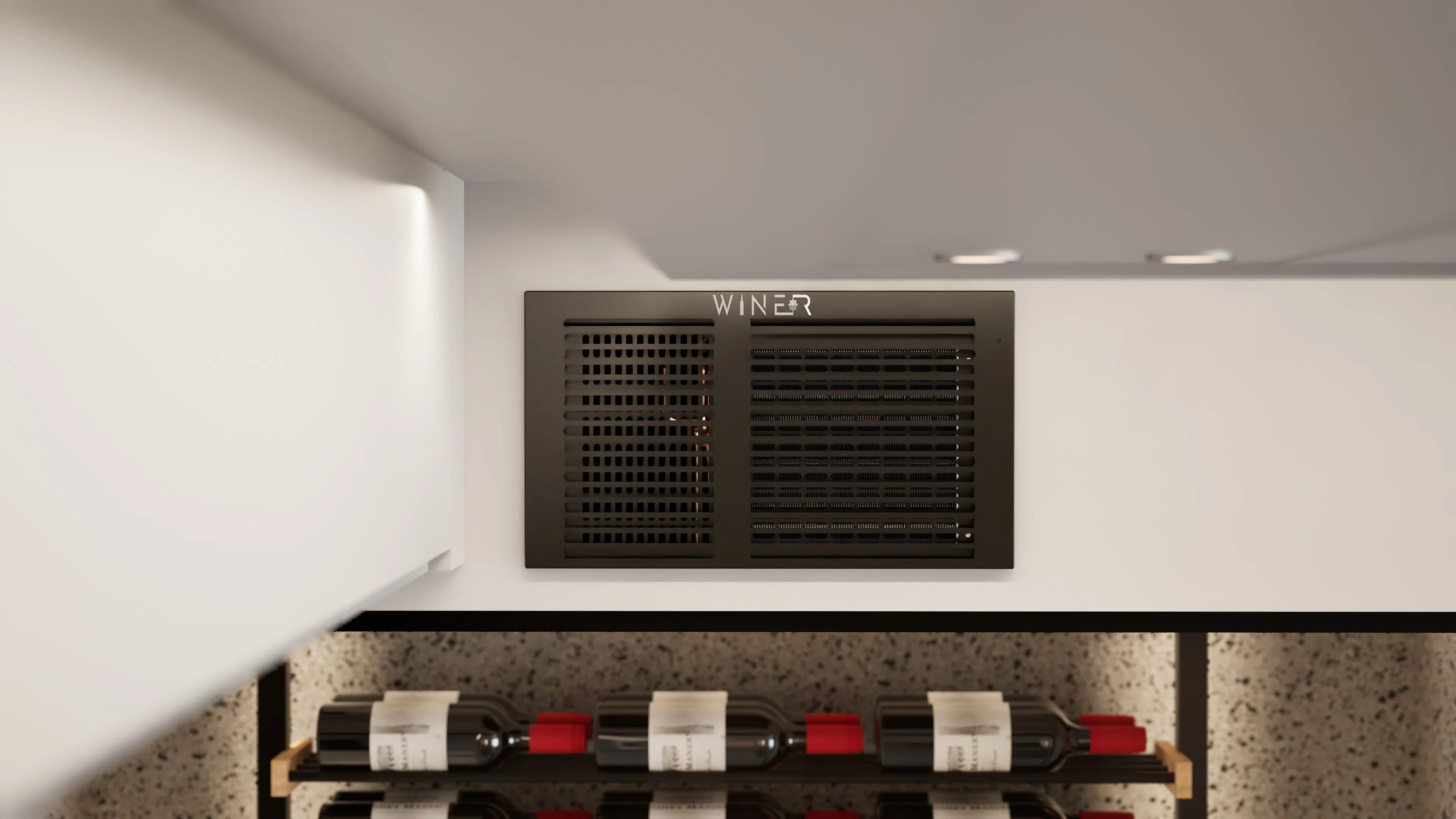
Who this guide is for
Homeowners with a cellar next to a conditioned room, owners replacing an existing through-the-wall unit (including KoolR Magnum), and DIY-comfortable builders planning a straightforward install.
Who this guide is not for
Cellars backed only by exterior walls, garages, or unconditioned spaces, and rooms built largely of glass. Those point to a ducted or split system sized to the actual load.
A through-the-wall wine cellar cooling unit is a self-contained cooler that mounts inside an interior wall and moves heat into the conditioned room next door, with no ducting and no refrigerant lines to run. It is the most direct way to cool a home cellar that sits beside a heated and cooled space, because the whole system lives in one housing set into a framed opening in the wall.
The appeal is simple: fewer parts, a straightforward install, and nothing visible outside the cellar except a grille. The limits matter just as much, and they come down to what sits on the other side of the wall and how well the room is built. This guide covers how these units work, when they fit, what the opening and power need to be, and how to size one, so you can tell whether a through-the-wall unit is right for your cellar before you buy.
How a through-the-wall unit works
A through-the-wall wine cellar cooling unit installs without refrigerant lines or ductwork; it sits in a framed opening in an interior wall, pulls warm air from the cellar, and exhausts heat through a grille into the adjacent room. Everything is in one housing: the evaporator faces the cellar, the condenser faces the neighboring space, and the compressor runs between them.
Because the heat has to go somewhere, that neighboring room does the work of carrying it away. In a home, that room is already heated and cooled, so it absorbs the load without trouble. The only things that leave the cellar are the grille on the far side of the wall and a condensate drain line. A wall controller sets and holds the cellar temperature.
That single-housing design is why this type is the quickest to install and the easiest to service. There is no line set to charge and no duct run to size, which removes the two steps that add the most cost and coordination to a cellar cooling project.
When a through-the-wall unit is the right fit
Three conditions decide whether this type fits your cellar.
A conditioned room next door. The unit exhausts heat into the adjacent space, so that space has to be able to take it. A basement, a hallway, a utility room, or any interior room that is already heated and cooled works well. A cellar backed only by an exterior wall, a garage, or an unconditioned attic has nowhere for the heat to go, and a ducted or split system is the better path there.
Insulation and sealing that hold conditions. Cooling equipment holds the cellar only as well as the room holds itself. R-20 insulation and a continuous vapor barrier are what let a wall-mounted unit reach and keep cellar temperature without running constantly. Older homes were rarely built to current cellar standards, and closing those gaps is straightforward once they are identified.
No large glass area. Glass adds heat load faster than an insulated wall. A cellar with a glass door and a small viewing panel is usually fine; a room built largely of glass moves heat faster than a wall-mounted unit is designed to handle, and it needs its load calculated directly rather than estimated from volume.
Most home cellars meet all three, which is why through-the-wall is the most common type in residential cellars.
What the wall opening and power need to be
A through-the-wall unit needs a framed opening in the interior wall, sized to the unit, with the grille finishing on the adjacent-room side. Exact opening dimensions vary by unit, so the spec sheet is the number that matters when you frame or when you match an existing opening.
On power, most residential through-the-wall units run on a dedicated 115V/60Hz/15A circuit. No high-voltage line is required, but the circuit must be dedicated: no shared loads, no extension cords, no switch-controlled outlets. You also plan for a condensate drain, either to a nearby drain or a small pump, and for service clearance on the adjacent-room side so the unit can be reached later.
Beyond having an electrician confirm or run the dedicated circuit, none of this asks for specialized trades in a typical install, which is part of why this type suits owners managing a straightforward cellar build rather than a ground-up custom project.
Replacing an existing through-the-wall unit
Many US cellars already have a through-the-wall unit in place, and a large share of those are KoolR Magnum units. KoolR Magnum was a popular through-the-wall option for years. With limited US availability for replacement units, owners replacing an aging unit are looking for a drop-in that fits the existing wall opening rather than a rebuild.
The thing to compare when you replace is the opening. If a new unit matches the same through-the-wall format and dimensions, the swap does not require reframing the wall or refinishing the room. The Wine-R WR2500 is a drop-in replacement for KoolR Magnum for this reason, same through-the-wall format and the same opening. If that is the situation you are in, the KoolR Magnum replacement guide covers the exact dimensions and steps.
How to size a through-the-wall unit
Sizing depends on the room, not the collection. A through-the-wall unit is matched to a cellar by volume, insulation level, sealing, and glass area, not by how many bottles the room holds. A well-built room asks less of a unit than a leaky one of the same size.
This type also has a practical ceiling on the load it handles, which is why sizing matters in both directions. The WR2500 is rated for cellars up to 700 ft³ (19.8 m³) with glass walls, or up to 900 ft³ (25.5 m³) fully enclosed, and a room within that envelope, built to R-20 with a proper vapor barrier, is a good match. A room beyond it, or one with a heavy glass load, points toward a ducted or split system instead. Oversizing is not a safety margin; it brings short cycling and uneven conditions rather than better cooling.
If you have your cellar's dimensions and insulation, the BTU calculator turns them into a sizing starting point in about a minute.
Frequently asked questions
It is a self-contained cooler that mounts in a framed opening in an interior cellar wall and exhausts heat through a grille into the conditioned room on the other side, without ductwork or refrigerant lines.
No. The whole system is in one housing set into the wall, so there is no line set to charge and no ducting to run. That is what makes this the simplest type to install.
A conditioned room that can absorb the exhausted heat, such as a basement, hallway, or utility room. A cellar backed by an exterior wall, garage, or unconditioned space needs a ducted or split system instead.
Yes. The step that matters is matching the wall opening so the swap does not require reframing. A drop-in replacement in the same through-the-wall format fits the existing opening; the KoolR Magnum replacement guide covers the exact dimensions.
It depends on the room's volume, insulation, and glass area rather than a fixed number. Residential through-the-wall units are commonly rated for cellars up to several hundred cubic feet, and the spec sheet for a given model gives the exact ceiling.
About this information
This content is general information for owners evaluating wine cellar cooling options. It is not a diagnosis of any specific unit and not a recommendation to repair or replace any product. Wine-R is not affiliated with, sponsored by, or endorsed by any other manufacturer referenced on this page. All third-party product names and trademarks are the property of their respective owners and are used for identification and compatibility reference only. Third-party specifications come from publicly available manufacturer information and may change without notice. Compatibility with an existing opening does not by itself confirm suitability: cooling capacity must be validated against the cellar's size and construction, and the WR2500 requires a condensate drain line and a dedicated 115V/60Hz/15A circuit. Fit and sizing are confirmed through Wine-R's pre-validation process before any unit ships.
Liability and warranty considerations
The WR2500 is sold under Wine-R’s Terms of Sale and Limited Warranty. Wine-R’s warranty covers unit parts for two years from the original purchase date.
Warranty coverage is voided by, among other conditions:
- Damage from improper installation, poor insulation, or oversized or unsealed rooms
- Use of extension cords, switch-controlled outlets, or non-dedicated circuits
- Use of single-pane or non-insulated glass in the cellar envelope
- Installation through an exterior wall, into a sealed cavity, or into an unventilated cabinet
- Service performed by anyone other than Wine-R or a Wine-R authorized technician
- Damage from drainage installation, blockage, overflow, or any drainage failure
Pre-validation by Wine-R confirms unit fitment against declared measurements only. The owner or installer is responsible for envelope construction, wall structural assessment, electrical compliance, drainage routing, and ongoing operating conditions. Wine-R does not warrant against water damage, mold, finish degradation, or property loss caused by installation, drainage configuration, site conditions, or operating environment.
About this guide
This guide is built and reviewed by the Wine-R engineering team. Wine-R specializes in through-the-wall wine cellar cooling and has supported replacements that reuse an existing opening across North America. Recommendations follow the WR2500 manufacturer specifications and standard residential building-science references.
See if it fits your cellar
A through-the-wall unit is the simplest path when your cellar sits next to a conditioned room and the room is built to hold its conditions. If you have your dimensions and insulation, the BTU calculator gives you a sizing starting point in a minute. To see a through-the-wall unit built for real homes, and a drop-in match for KoolR Magnum openings, see the WR2500.
Compare published specs for the WR2500 next to other through-the-wall units on the through-the-wall wine cooling unit comparison.