
Published · Last updated
Wine Cellar Humidity Control: What the Room Decides
The WR2500 does not add or control humidity. What keeps a cellar's humidity steady is the room: insulation, vapor barrier and an airtight door.
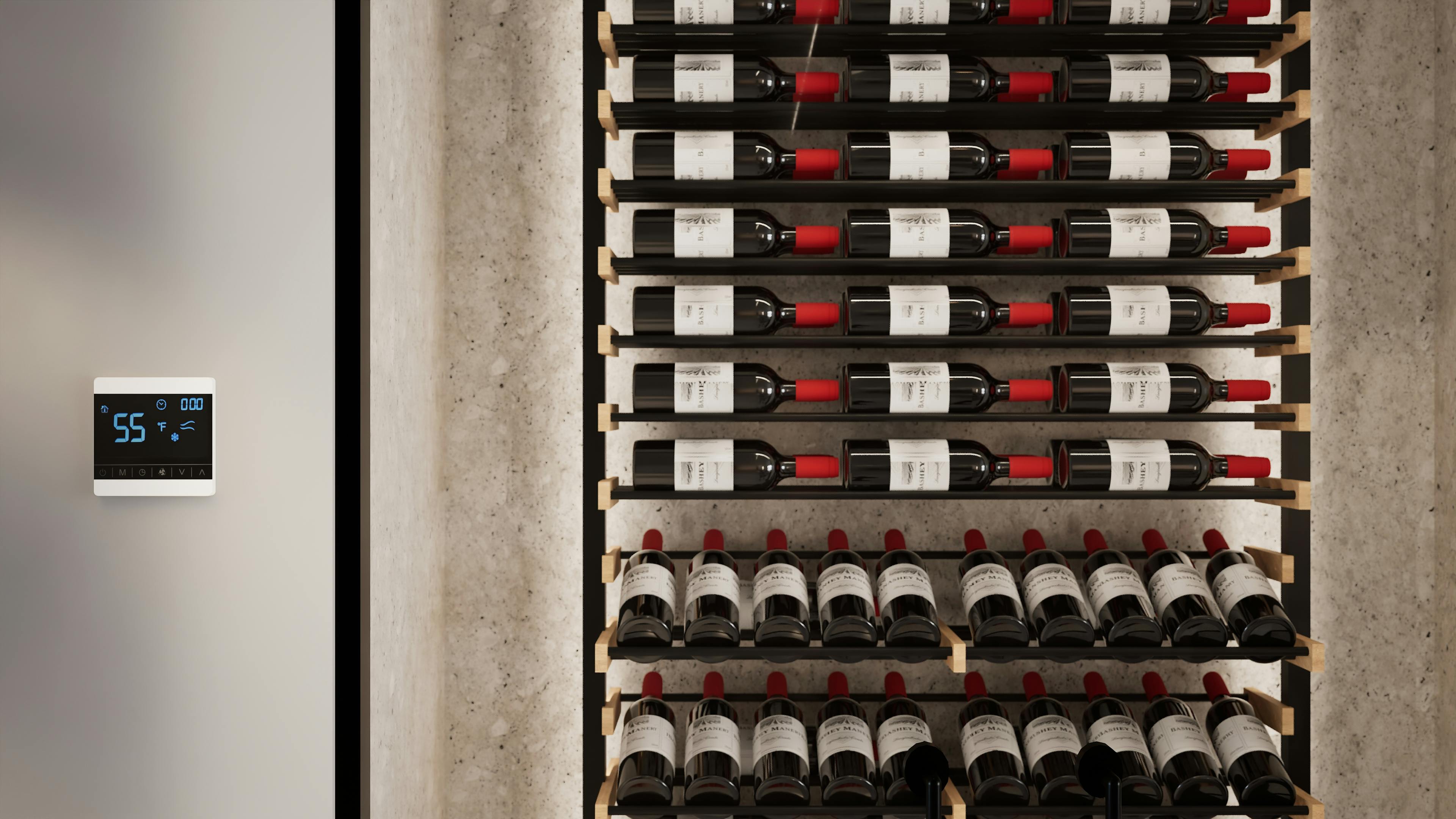
The Wine-R WR2500 does not control humidity. It cools the room and does not add or regulate moisture, so steady humidity in a cellar comes from how the room is built.
What keeps humidity steady
Humidity in a cellar settles at a stable level when the room is closed off from outside air. Four things do that work.
- R-20 or better insulation in the walls, ceiling and floor, so surfaces stay near the room's own setting.
- A continuous, sealed vapor barrier, so moisture does not move through the walls.
- An airtight door with a good seal, since each gap lets room air in.
- Sealed penetrations, such as outlets, light boxes and pipe holes.
In a room built this way, humidity commonly settles between 55 and 70 percent without equipment to manage it.
Why a sealed room holds its level
Air carries moisture, and moisture moves toward wherever the air is drier. A cellar that trades air with the rest of the house, or with the outdoors, keeps getting pulled toward the humidity of those spaces. Seal the room and that exchange stops. What remains is a small volume of air with a fixed amount of moisture in it, and that holds steady.
The vapor barrier does the same job inside the walls. Without a continuous barrier, moisture travels through the wall material, and the room follows the humidity of the space behind it.
What a cooling unit does for humidity
The unit's job is steady cooling. A system that cycles hard through large swings can stir the room's conditions. A right-sized unit that runs steadily keeps conditions calmer, and that helps the room hold its level. It does not add moisture. A household air conditioner behaves differently: see the wine cellar air conditioner guide.
How to measure it
You cannot manage what you have not measured, and a small digital hygrometer is inexpensive. A few habits make the reading useful.
- Place it at mid-height, a little away from the unit's grille and away from the door, where the air is typical of the room.
- Read it over several weeks, not one afternoon. Humidity shifts with the seasons and with each time the door opens.
- Note the range, not a single number. A steady reading that moves a few points is a healthy room.
What too dry and too damp look like
Too dry
Corks may feel brittle, labels may curl, and the reading sits low week after week.
Too damp
The reading sits high week after week, labels and cardboard soften, and a musty smell can develop.
Either way
Both are signals about the room's envelope, and both have straightforward fixes.
When a room runs dry
In a very dry climate, or a room that is not fully sealed, humidity can sit below the comfortable level. Three steps help.
- Seal the room first. Door seal, outlet gaskets and a complete vapor barrier.
- Add a separate room humidifier if the level stays low after sealing. It is separate equipment and is not part of the cooling unit.
- Re-check the reading over several weeks before changing anything else.
When a room runs damp
High humidity most often points to a gap in the room's envelope. Check the envelope first, then confirm the condensate line meets the installation requirement: a continuous downward slope to a drain or pump. Older homes were rarely built with cellar standards, and the fixes are straightforward. Check these first.
- The door seal, around the full perimeter and at the threshold.
- The vapor barrier, for gaps at seams and edges.
- The condensate line, which should slope down continuously to a drain or pump.
If the envelope checks out and the reading stays high, a separate dehumidifier is the equipment for it. It is not part of the cooling unit.
A short checklist
Run through these six points before looking anywhere else.
- Walls, ceiling and floor insulated to R-20 or better.
- Vapor barrier continuous, with seams and edges sealed.
- Door with a full perimeter seal and no gaps at the threshold.
- Outlets, light boxes and pipe holes sealed.
- Glass, if any, is double-pane and sealed.
- Condensate line sloping down continuously to a drain or pump.
If every item checks out and the reading is still off, the cause is usually one gap that is easy to miss, and a slow walk around the room with the light off and a flashlight behind the door often finds it.
FAQ
No. It does not add or regulate humidity. Humidity comes from the room's construction.
A well-built cellar commonly settles between 55 and 70 percent.
Not in a properly sealed room in most climates. In a very dry climate, a separate room humidifier can help.
Any cooling unit removes some moisture as it cools. In a sealed room with a continuous vapor barrier the effect is small and the level holds. If the reading is low, check the room's seal first, then consider a separate humidifier.
Check the vapor barrier, door seal, and that the condensate line slopes down continuously to a drain or pump.
At mid-height, a little away from the unit's grille and the door, and read it over several weeks.
Liability and warranty considerations
The WR2500 is sold under Wine-R’s Terms of Sale and Limited Warranty. Wine-R’s warranty covers unit parts for two years from the original purchase date.
Warranty coverage is voided by, among other conditions:
- Damage from improper installation, poor insulation, or oversized or unsealed rooms
- Use of extension cords, switch-controlled outlets, or non-dedicated circuits
- Use of single-pane or non-insulated glass in the cellar envelope
- Installation through an exterior wall, into a sealed cavity, or into an unventilated cabinet
- Service performed by anyone other than Wine-R or a Wine-R authorized technician
- Condensate drain not installed to the published requirements (3/8 in ID, continuous downward slope, pump where required)
Pre-validation by Wine-R confirms unit fitment against declared measurements only. The owner or installer is responsible for envelope construction, wall structural assessment, electrical compliance, drainage routing, and ongoing operating conditions. Wine-R is not liable for incidental, consequential, special, or indirect damages, including damage to property or to the contents of the wine cellar, arising from installation, site conditions, or operating environment. See the Terms of Sale.
About this information
This content is general information for owners evaluating wine cellar cooling options. It is not a diagnosis of any specific unit and not a recommendation to repair or replace any product. Wine-R is not affiliated with, sponsored by, or endorsed by any other manufacturer referenced on this page. All third-party product names and trademarks are the property of their respective owners and are used for identification and compatibility reference only. Third-party specifications come from publicly available manufacturer information and may change without notice. Compatibility with an existing opening does not by itself confirm suitability: cooling capacity must be validated against the cellar's size and construction, and the WR2500 requires a condensate drain line and a dedicated 115V/60Hz/15A circuit. Fit and sizing are confirmed through Wine-R's pre-validation process before any unit ships.
About this guide
This guide is built and reviewed by the Wine-R engineering team. Wine-R specializes in through-the-wall wine cellar cooling. Recommendations follow the WR2500 manufacturer specifications and standard residential building-science references.
See if it fits your cellar
Steady humidity starts with a sealed, insulated room. If you want to check how your room is built before choosing a cooling unit, the BTU calculator is a good first step, and the compatibility check shows whether an existing opening fits. For sizing a room, see the wine room cooling unit guide. To see the through-the-wall unit, see the WR2500.