Complimentary shipping · Through Sept 30

For interior designers and millwork

Specify the WR2500 without boxing the unit

The WR2500 sits in the cellar wall, usually above the door. Millwork can frame the face. It cannot close the airflow, cover the warm side, or trap the chassis so it cannot come out for service.

By

Through-the-wall wine cellar cooling

Reviewed · September 3, 2026

The WR2500 is a factory-charged through-the-wall wine cellar cooling unit. The face is in the cellar wall. There is no remote compressor to hide in another room. Cold side needs 12 in of clear space. Warm side needs 18 in and a room that can take rejected heat. A glass door adds load. A glass wall is a different room. Size after the envelope is confirmed, not after the millwork drawing.

On the job

Takeaways

  1. 01The face is in the cellar wall. There is no remote compressor to hide in another room.
  2. 02Cold side needs 12 in of clear space. Warm side needs 18 in and a room that can take rejected heat.
  3. 03A glass door adds load. Size after the envelope is confirmed, not after the millwork drawing.
  4. 04Leave a path to remove the unit without dismantling finished cabinetry.
  5. 05Apply for Pro to save the job and request a spec review.

Finish around the wall

Grille, glass, and what the client actually sees

The face

The unit is in the wall, usually above the door. Spec the opening from the cut sheet, not from a furniture catalog.

Glass load

A glass door raises the load. A glass wall is a different room. Do not size a leaky box and hope the unit catches up.

Service

Hide fasteners, not airflow. If millwork has to come apart to pull the chassis, the drawing is not done.

Sound

The WR2500 rejects heat and sound at the wall. In a living space, plan the warm side away from seating where possible. It is a cooling unit, not a silent appliance.

From a real build

Frame it, do not box it

Basement cellar cold side: WR2500 grille mounted flush above the black cellar door, wall controller beside it

Cold side

Above the door, flush with the wall. The grille and the controller are all the client ever sees.
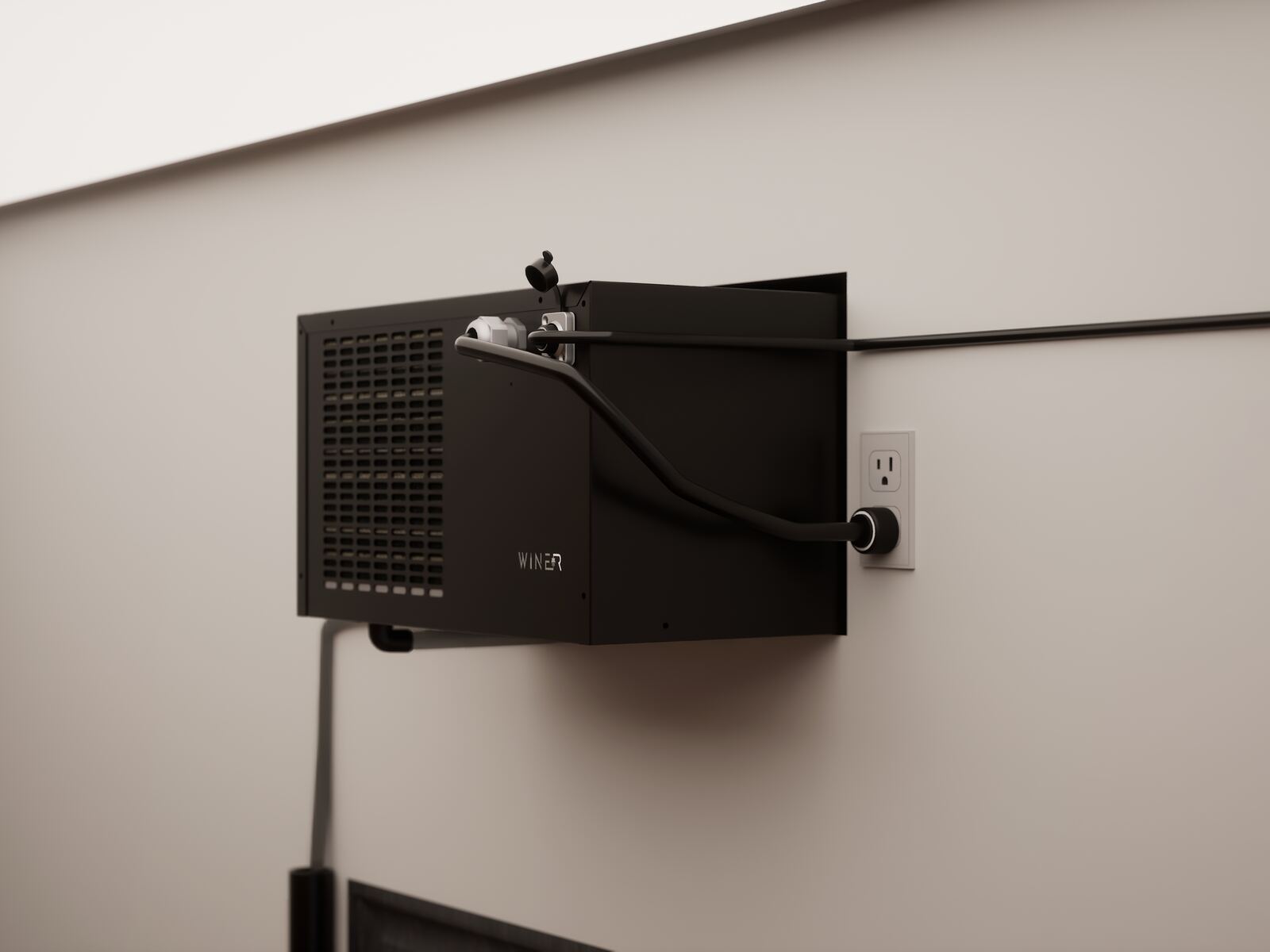
Warm side of the same wall: WR2500 chassis left open on the wall with a dedicated outlet, power cord, and condensate drain line

Warm side

The chassis stays open to the room: dedicated 115V outlet, sloped drain, clear air on every face. Millwork never wraps it.

Before millwork is ordered

What to lock with the GC

  1. 01Non-loadbearing interior wall. Exterior walls are not the install.
  2. 02Cutout 15 5/8 in by 9 1/4 in. Walls 5.5 to 14 in thick.
  3. 03Dedicated 115V / 60Hz / 15A outlet, not on a wall switch.
  4. 04Condensate drain with continuous downward slope.
  5. 05Warm-side room that can accept rejected heat.

Specification sequence

How to specify the WR2500

For cellars that have to look finished with a through-the-wall unit in the wall. The drawing set carries the envelope, the load, the opening, the drain, and the electrical. There is no remote compressor to hide in another room.

  1. 1. Confirm the envelope. R-20 walls and floor, sealed vapor barrier on the warm side. Double-pane sealed glass only. Single-pane and non-insulated glass are not permitted and void warranty coverage.
  2. 2. Size the load. Enter length, width, height, glass, and insulation in the BTU calculator. The WR2500 covers up to 700 ft³ (19.8 m³) with glass walls or 900 ft³ (25.5 m³) fully enclosed when the envelope meets specification.
  3. 3. Place the unit. A non-loadbearing interior wall, 5.5 to 14 in thick. Cutout 15 5/8 in by 9 1/4 in, typically above the door. The face is in the cellar wall.
  4. 4. Route the drain. Mandatory 3/8 in ID condensate line with continuous downward slope. Runs over 5 ft, rises, or loops need a pump.
  5. 5. Electrical. Dedicated 115V/60Hz/15A. Do not share the circuit with lighting. No extension cord. No switched outlet.
  6. 6. Installation. DIY-feasible when the site is correct. A contractor or HVAC installer can set it. Wine-R does not certify installers.

Millwork can frame the face if free area and published clearances stay open. Leave a path to remove the unit without dismantling finished cabinetry. 2-year parts warranty.

Lunch and learn

Specifying the WR2500

Lunch and learn for design teams

A one-hour session, on site or remote, for interior designers, architects, millwork, and design-build teams specifying through-the-wall cooling for residential and hospitality cellars. The objective is a drawing set that keeps the grille unobstructed and the chassis removable.

  1. 1. Through-the-wall unit in the cellar wall, typically above the door. There is no remote compressor.
  2. 2. A glass door adds load. A glass wall is a different room. Size after the envelope is confirmed.
  3. 3. Cutout 15 5/8 in by 9 1/4 in. Walls 5.5 to 14 in. Interior walls only.
  4. 4. Dedicated 115V/60Hz/15A circuit and a sloped condensate drain.
  5. 5. DIY-feasible when the site is correct. Wine-R does not certify installers.

Definitions

Through-the-wall wine cellar cooling unit:
A self-contained unit set in the cellar wall. The face is visible in the room. Heat rejects into the adjoining space.
Specify-WR2500 one-pager:
A one-page sequence listing envelope, load, opening, drain, electrical, and installation for the WR2500, written for the general contractor.
Glass load:
The additional cooling load created by glazing. A glass door raises the load. A glass wall is sized as a different room from the BTU calculator.

Common questions

Role FAQ

Can cabinetry surround the WR2500?
A frame or grille surround is fine if free area and the published clearances stay open. Do not enclose the chassis. The owner is responsible for service access.
What do I send the client?
The installation reference and the cutout: 15 5/8 in by 9 1/4 in, walls 5.5 to 14 in. After you apply, save the project in the workspace and share the link.
Does an existing opening mean it drops in?
No. An opening in the published range is one part of the picture. Capacity, a condensate drain, and a dedicated 115V circuit still have to be confirmed.

Back to Wine-R Pro. Related: BTU calculator, Documentation, Compatibility check, R-20 insulation, Vapor barriers.

Apply for Pro

One portal. Seven roles.

Approval is a human review. No auto-approve on pricing. You are applying directly with Wine-R, not through a dealer.

Specification support notice

Wine-R Pro documents support design, bid, and specification work. They are not a site assessment, an engineering approval, or an installation certification. Final sizing, opening, drainage, and electrical are confirmed on site by the responsible trades. Wine-R does not install and does not certify installers. The WR2500 is sold under Wine-R’s Terms of Sale and Limited Warranty.

Liability and warranty considerations

The WR2500 is sold under Wine-R’s Terms of Sale and Limited Warranty. Wine-R’s warranty covers unit parts for two years from the original purchase date.

Warranty coverage is voided by, among other conditions:

  • Damage from improper installation, poor insulation, or oversized or unsealed rooms
  • Use of extension cords, switch-controlled outlets, or non-dedicated circuits
  • Use of single-pane or non-insulated glass in the cellar envelope
  • Installation through an exterior wall, into a sealed cavity, or into an unventilated cabinet
  • Service performed by anyone other than Wine-R or a Wine-R authorized technician
  • Damage from drainage installation, blockage, overflow, or any drainage failure

Pre-validation by Wine-R confirms unit fitment against declared measurements only. The owner or installer is responsible for envelope construction, wall structural assessment, electrical compliance, drainage routing, and ongoing operating conditions. Wine-R does not warrant against water damage, mold, finish degradation, or property loss caused by installation, drainage configuration, site conditions, or operating environment.
