
Published · Last updated
How to size a wine cellar cooling unit: a practical guide
Two numbers decide whether a wine cellar cooling unit fits a cellar: cubic footage and glass coverage. The Wine-R WR2500 covers cellars up to 700 cubic feet with glass walls and up to 900 cubic feet in fully enclosed cellars; larger cellars are reviewed case by case by our technical team. Run the BTU calculator to get a WR2500 fit verdict in under a minute.
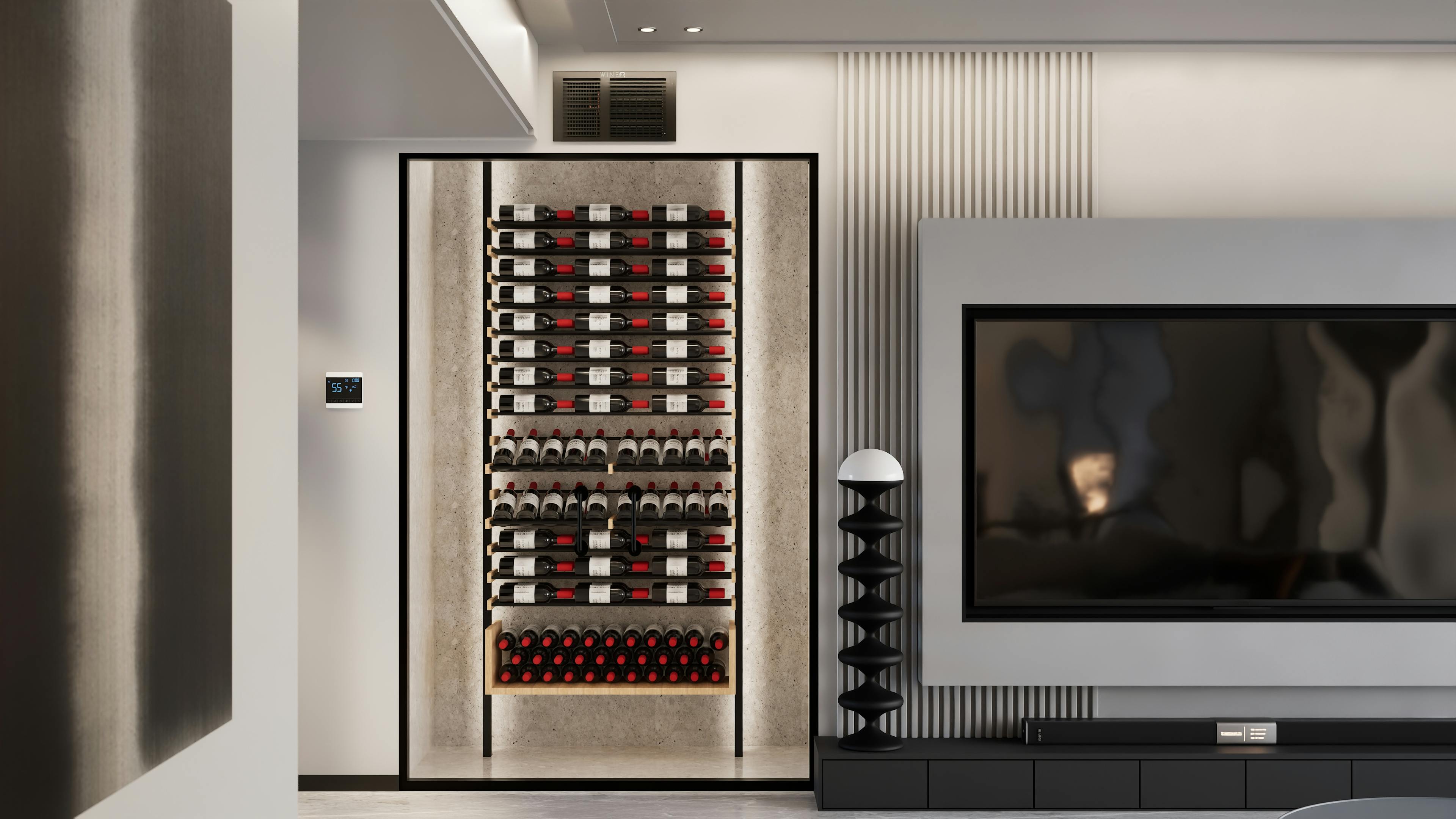
The short answer
A through-the-wall self-contained cooling unit is the right architecture for most cellars between 50 and 1,500 cubic feet, when the cellar shares a wall with a non-conditioned space for warm-side venting.
The Wine-R WR2500 covers cellars up to 700 cubic feet with glass walls and up to 900 cubic feet in fully enclosed cellars, which is where the majority of American wine cellars sit. The calculator returns a WR2500 fit verdict in under a minute.
For cellars beyond standard WR2500 capacity, our technical team reviews your project case by case to confirm the right configuration. Above 1,500 cubic feet, or for cellars with no warm-side venting, a ducted split is the right architecture.
Effective volume is the actual cellar volume (length times width times height), adjusted upward for glass coverage. Glass exposes the cellar to roughly 4 to 6 times more heat per square foot than insulated walls, so a glass-walled cellar behaves like a larger insulated cellar.
Homeowners, builders, restaurants, and commercial buyers
Anyone sizing a wine cellar cooling unit between 50 and 1,500 cubic feet of effective volume. Covers WR2500 sizing, when to request a case-by-case review by Wine-R, and when a ducted split becomes the right architecture.
How many BTUs does a wine cellar cooling unit need?
Most residential wine cellars need roughly 1,000 to 3,500 BTU per hour, but the figure comes from the room's heat load, not from bottle count. The Wine-R WR2500 delivers 2,337 BTU per hour, which is why it covers cellars up to 700 cubic feet with glass walls, or up to 900 cubic feet in fully enclosed cellars, when the room is built to R-20 or better.
The heat-load calculation is simpler than it sounds. Start with the room's volume for a base figure, then adjust up for anything that adds heat: insulation below R-20, an exterior or above-grade wall, a ceiling under a warm attic, and above all glass, which gains heat far faster than an insulated surface and is counted on its own. The larger the gap between the cellar setpoint and the spaces around it, the more capacity the room needs to hold steady.
Room size alone rarely changes the answer for a well-built cellar. A sealed, R-20 closet of 50 cubic feet, a 100 cubic foot room with a single glass door, and a 200 cubic foot enclosed cellar all sit comfortably inside a single through-the-wall unit. What moves the number is the envelope: a 200 cubic foot cellar with a full glass wall and a warm adjacent space can ask more than a 400 cubic foot sealed one. Enter your dimensions, insulation, and glass into the BTU calculator for a firm figure in about a minute.
The two variables that decide fit
Cubic footage
Length times width times ceiling height. This is the base of the calculation. Measure with the full ceiling height included. Tall cellars need more cooling than the floor area alone suggests. Closets, alcoves, and stair voids that share air with the cellar count toward the conditioned volume.
Glass coverage as a percent of total wall area
Glass is a thermal liability. Standard insulated glass has an R-value of 3 to 4. An insulated wall is R-15 to R-25. Per square foot of exposure, a glass wall lets through roughly 4 to 6 times more heat than an insulated wall.
The calculator translates glass coverage into a capacity adjustment. At 0 percent glass (a fully enclosed cellar), the WR2500 handles cellars up to 900 cubic feet. With substantial glass walls or a large glass door, that drops to roughly 700 cubic feet. The relationship is symmetric: more glass means a smaller cellar can still fit; less glass means a larger cellar.
Other factors (insulation R-value, climate zone, where the cellar shares walls with conditioned space) affect how the unit performs over the long run, not whether it fits. Those are build-quality factors, covered later.
What the calculator returns for typical cellar sizes
Verdict definitions
- Good fit: the WR2500 has comfortable capacity headroom for the cellar.
- Adequate: the WR2500 will work but is close to its sizing limit. Performance is sensitive to insulation and climate.
- Custom review: the cellar requires individual evaluation by our technical team. Depending on layout, insulation, glazing, and target temperature, a single WR2500 may still cover the space, or a multi-unit configuration may be the right answer. Submit your project for evaluation.
What if my cellar exceeds WR2500 capacity
The WR2500 covers cellars up to 700 cubic feet with glass walls and up to 900 cubic feet in fully enclosed cellars. Larger cellars are reviewed case by case by our technical team.
Depending on layout, insulation, glazing, and target temperature, several configurations apply: a single WR2500 may still cover the space depending on glass coverage, a multi-unit configuration may be the right answer, or a ducted split architecture is needed for cellars above 1,500 cubic feet or installations with commercial duty cycles.
Submit your project details and our technical team will come back with a recommendation within one business day.
Glass-walled cellars
Glass exposure significantly increases the effective heat load. A cellar with substantial glass coverage may require a configuration different from cellars without glass. The right size and unit configuration depends on layout, glass exposure, and target temperature.
Cellars without warm-side venting access
A ducted split is required regardless of size when no non-conditioned space (garage, utility room, mechanical closet) is available for warm-side exhaust. Through-the-wall units cannot exhaust heat into a conditioned room without performance degradation.
When through-the-wall is the right architecture
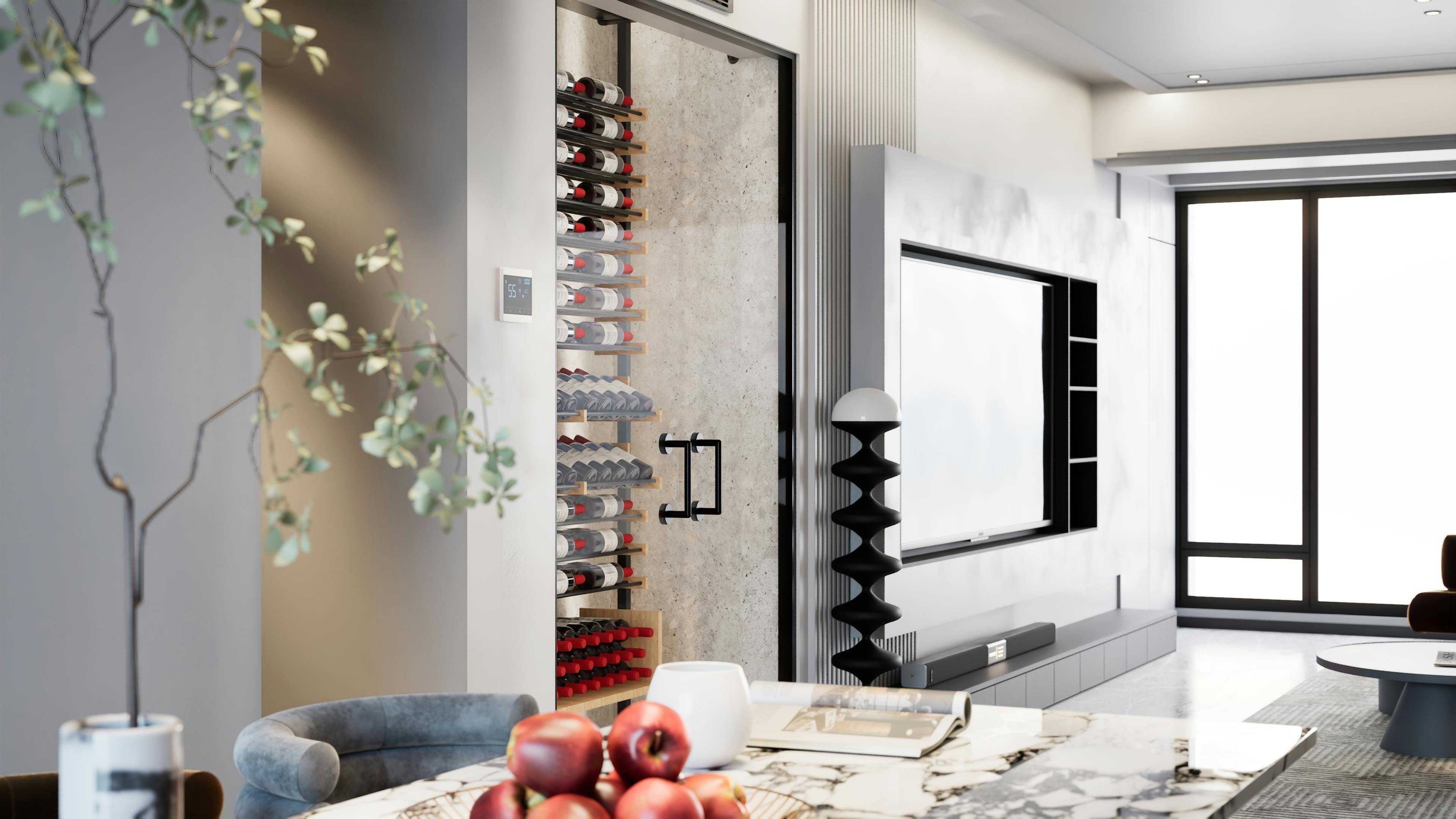
A through-the-wall self-contained unit like the Wine-R WR2500 is the right call when three conditions are met. The calculator returns Good fit or Adequate. The cellar has R-20 minimum insulation. A non-conditioned space (garage, utility room, mechanical closet) is available on one side of a wall for warm-side venting.
Most American homes renovating a basement or converting a closet meet all three conditions. The benefits of through-the-wall include a single self-contained unit, no refrigerant lines, no ductwork, a standard 120V/15A outlet (for the WR2500), faster install, and lower cost than a ducted split. A weekend renovation can have a cooled cellar by Sunday evening.
When you need a ducted split system
A ducted split is the right architecture when any of the following apply. The cellar is above 1,500 cubic feet of effective volume. The cellar has glass walls or large glass doors regardless of size. The cellar has no adjacent non-conditioned space available for warm-side venting. The cellar requires condenser placement remote from the cellar. The installation has commercial duty cycle requirements.
In a ducted split, the condenser sits outside or in a remote utility space, refrigerant lines connect to an evaporator coil in the cellar, and ducts handle air distribution. Trade-offs: higher install cost, refrigerant line routing required, professional installation needed. Benefits: capacity scales to large cellars, glass exposure can be handled, the condenser can be located wherever the build allows.
What affects long-term performance
The calculator answers a single question: does the cellar fit. Insulation R-value, climate zone, and where the cellar shares walls with conditioned space affect how the unit performs over the years, not whether it fits. R-20 minimum insulation is recommended for the WR2500. Below R-20, the compressor cycles more often than designed and wears faster, even if the cellar size is comfortably in range.
Insulation, climate, and the cellar boundary
The calculator does not factor these in because they are build-quality decisions, not sizing decisions. A correctly sized unit in a poorly built cellar will struggle. A correctly sized unit in a well-built cellar will perform reliably for a decade or more.
Insulation R-value
R-20 is the minimum we recommend for the WR2500. Below R-20, the cooling unit cycles more often than designed, the compressor wears faster, and the cellar temperature swings more than the wine should see. Adding insulation costs less than buying a larger cooling unit, and a larger unit will not fix an under-insulated space. Below R-15, even a properly sized unit struggles in summer.
Climate zone
Hot ambient temperatures mean more heat conducts through the walls, regardless of insulation. The unit cycles more in summer than winter, and a hot region has more total summer runtime. The difference between a Houston cellar and a Minneapolis cellar with identical construction is real and shows up in compressor runtime over a hot summer.
Where the cellar shares walls
A cellar entirely inside the conditioned building envelope (basement, interior walls bordering conditioned rooms) has the lowest heat load. A cellar bordering a garage, attic, or non-conditioned utility room has higher load on that boundary. A cellar with an exterior wall has the highest load. The fix on the exterior-wall case is upgrading the insulation to R-25 or higher, not buying a larger unit.
These three factors interact. R-15 in Houston is a problem. R-25 in Minneapolis is overkill. The practical move is to insulate to R-20 minimum, place the cellar inside the envelope when possible, and let the calculator fit verdict guide unit sizing.
Common sizing mistakes
- Oversizing the unit to be safe. A cooling unit that is too large for the cellar cycles on and off frequently. Frequent cycling wears the compressor faster than running at design load, and cellar temperature swings more than the wine should see. The right size is the calculator fit verdict, not a safety margin.
- Measuring floor area instead of cubic feet. Ceiling height matters as much as floor footprint. A 10 by 10 cellar with an 8-foot ceiling has 800 cubic feet. The same footprint with a 12-foot ceiling has 1,200 cubic feet, which exceeds standard WR2500 capacity and triggers a Custom review.
- Ignoring glass coverage. A cellar with 30 percent glass behaves like a meaningfully larger cellar without glass. Glass is the single biggest swing factor in residential cellar sizing.
- Buying a larger unit to fix poor insulation. A larger unit cannot compensate for an under-insulated cellar. The unit will run more, wear faster, and the cellar will still swing in temperature. Insulation is the better dollar.
- Forgetting the warm-side venting space. A through-the-wall unit exhausts heat into the adjacent room. Without an adequate non-conditioned space on the other side of the wall, the unit overheats. If no warm-side space is available, the architecture has to be a ducted split.
Common sizing questions
The Wine-R WR2500 covers cellars up to 700 cubic feet with glass walls and up to 900 cubic feet in fully enclosed cellars. A 700 cubic foot insulated cellar with no glass is a Good fit. A 900 cubic foot cellar with 30 percent glass coverage triggers a Custom review.
Larger cellars are reviewed case by case. The WR2500 covers up to 700 cubic feet with glass walls and up to 900 cubic feet in fully enclosed cellars. Anything beyond that goes through a structured submission process and we come back with a recommendation within one business day.
Roughly 1,500 cubic feet of effective volume is the practical upper limit for through-the-wall units. Above that, a ducted split system is the right architecture.
Good fit: the WR2500 has comfortable capacity headroom. Adequate: the WR2500 will work but is close to its sizing limit. Custom review: the cellar requires individual evaluation by our technical team to confirm the right configuration.
Oversizing causes more problems than undersizing. A unit that is too large for the space cycles on and off frequently, which wears the compressor faster and makes cellar temperature swing more than the wine should see. The right size is the calculator fit verdict, not a safety margin.
Break the cellar into rectangular sections, calculate length times width times height for each, and add them together. Closets, alcoves, and stair voids that share air with the cellar count toward the conditioned volume.
Yes. The calculator uses total cubic feet, not floor area. A 10 by 10 cellar with an 8-foot ceiling has 800 cubic feet. The same footprint with a 12-foot ceiling has 1,200 cubic feet, which exceeds standard WR2500 capacity and triggers a Custom review.
No. The calculator answers a single question: does the WR2500 fit the cellar size. Insulation affects how the unit performs over the years, not whether it fits. R-20 minimum insulation is recommended. Below R-20, the unit cycles more often than designed and wears faster, even if the cellar size is comfortably in range.
The calculator returns the same fit verdict regardless of climate. Climate affects long-term performance, not fit. Hot climates (Houston, Phoenix, Miami) push the compressor harder during summer months. In hot climates, insulating above R-20 and locating the cellar inside the conditioned envelope is more important than upsizing the unit.
A through-the-wall unit needs a non-conditioned space (garage, utility room, mechanical closet) on the warm side of the wall to exhaust heat. Without one, the unit overheats and shuts down. If no warm-side space is available, the architecture has to be a ducted split, regardless of cellar size.
Most residential cellars need about 1,000 to 3,500 BTU per hour, set by a heat-load calculation rather than bottle count. The load depends on the room's volume, insulation, glass area, sealing, and the temperature of the surrounding spaces. The WR2500 delivers 2,337 BTU per hour, which covers cellars up to 700 cubic feet with glass walls or up to 900 cubic feet in fully enclosed cellars.
Start from the room’s volume for a base heat gain, then adjust up for insulation below R-20, exterior or above-grade walls, and the temperature gap to the spaces around the cellar. Glass area is added separately because it gains heat much faster than an insulated wall. A BTU calculator applies these factors and returns the capacity the unit needs to hold cellar temperature.
About this information
This content is general information for owners evaluating wine cellar cooling options. It is not a diagnosis of any specific unit and not a recommendation to repair or replace any product. Wine-R is not affiliated with, sponsored by, or endorsed by any other manufacturer referenced on this page. All third-party product names and trademarks are the property of their respective owners and are used for identification and compatibility reference only. Third-party specifications come from publicly available manufacturer information and may change without notice. Compatibility with an existing opening does not by itself confirm suitability: cooling capacity must be validated against the cellar's size and construction, and the WR2500 requires a condensate drain line and a dedicated 115V/60Hz/15A circuit. Fit and sizing are confirmed through Wine-R's pre-validation process before any unit ships.
Liability and warranty considerations
The WR2500 is sold under Wine-R’s Terms of Sale and Limited Warranty. Wine-R’s warranty covers unit parts for two years from the original purchase date.
Warranty coverage is voided by, among other conditions:
- Damage from improper installation, poor insulation, or oversized or unsealed rooms
- Use of extension cords, switch-controlled outlets, or non-dedicated circuits
- Use of single-pane or non-insulated glass in the cellar envelope
- Installation through an exterior wall, into a sealed cavity, or into an unventilated cabinet
- Service performed by anyone other than Wine-R or a Wine-R authorized technician
- Damage from drainage installation, blockage, overflow, or any drainage failure
Pre-validation by Wine-R confirms unit fitment against declared measurements only. The owner or installer is responsible for envelope construction, wall structural assessment, electrical compliance, drainage routing, and ongoing operating conditions. Wine-R does not warrant against water damage, mold, finish degradation, or property loss caused by installation, drainage configuration, site conditions, or operating environment.
About this guide
This guide is built and reviewed by the Wine-R engineering team. Wine-R specializes in through-the-wall wine cellar cooling and has supported replacements that reuse an existing opening across North America. Recommendations follow the WR2500 manufacturer specifications and standard residential building-science references.
See if the WR2500 fits your cellar
The BTU calculator runs the same fit check walked through above: cubic footage plus glass coverage, compared against the WR2500 effective capacity. A few minutes there will tell you whether the unit is a Good fit, Adequate, or whether your cellar needs a Custom review. The Wine-R WR2500 is $2,450 USD, ships free to all 48 contiguous US states, and comes with a 2-year limited parts warranty supported by the Wine-R North American service team.